
What most people have in mind when you compare ‘Denmark’ and ‘Indonesia’ is that they are often more focused on the parts of ‘how great differences between the two countries are’. Weather, culture, food, people, etc. As an Indonesian, I got asked a couple of times by some people (mostly the locals) about how it was for me when I was new in Denmark, what were the differences between these two countries, if I encountered a big culture shock, and similar types of questions. I am not entirely sure if those questions were meant as a pure curiosity and sympathetic kind of questions or an attempt to hear some funny stories from my mouth. So, this story is largely based on my experience and observation, as an Indonesian who has lived for 6 years in Denmark.
While it is true that there are some differences (which are easier to spot for most people), I wonder, why don’t people try to focus more on similarities that might build closer relationships and foster collaborations? As an important note, in Indonesia, I was born and spent most of my years in Yogyakarta, but then studied and worked in Jakarta, and in Denmark, I have so far lived in Aarhus, Copenhagen, and Tønder. They are not representative of the whole Denmark and Indonesia, of course. All the aforementioned cities are very different one another, though, but that only gives me some advantages. My stays there have definitely broaden my horizon too. As a disclaimer, the places where I have lived also contribute to shaping this article. I know that the title above sounds a bit provocative, but that was intentionally made, to make you, as a reader think, before starting to scroll down. So, any ideas? I do have some ideas.

Samsø, Denmark — that almost looks like Komodo island in Indonesia
1. Countries with Many Islands and Beaches
In Indonesia, we have 17,491 islands registered, while in Denmark there are 406 islands. With this feature, of course, there are numerous amounts of beaches surrounding the country or even just in the middle of the country. Before moving to Europe, I thought that having beaches close to you is normal, and I do take this natural beauty for granted in almost all my life. However, many other countries in Europe don’t have this luxury at all, and they need to travel abroad just to go seeing the sea. How come? Well, if their country is basically located in one land named Europe with the direct land borders of the neighboring countries and no sea nearby, of course, that means no beaches at all. Most Danes love beaches so do Indonesians. I mean, who doesn’t? Most of us enjoy seeing the white sand and the blue sea. There are only two major differences, though. First, in the Indonesian seas, if you snorkel or dive, as the weather is warm, you will in most cases find coral reefs and of course, large biodiversity resulted from the warm climate. These large coral reefs probably don’t exist anywhere in Europe due to the climate. Second, many Danes enjoy sunbathing on the beach, while Indonesians normally just lay on the beach with a big sunshade to cover them. Contrast to the Danes, many Indonesians don’t like to get (more) burnt or simply don’t wish to get a darker shade due to many reasons. Some of us even use an umbrella in a 33-degree Celsius sunny day to protect our face.
2. Sense of HUMOR
Danes are known for their sarcastic humor. In another way, they are simply known for throwing jokes almost everywhere, even in politics. I heard that this ‘kind of humor’ doesn’t resonate with some internationals, but to me, it resonates almost perfectly 😀 Indonesia is a very diverse society with hundreds of ethnicities, but from what I know, the majority of Indonesians love sarcastic and slapstick humor. We exercise them every day, sometimes in a harsh way too. As a Javanese and Yogyakartan born Indonesian, I got used to this kind of jokes. I make sarcastic jokes almost in a daily basis, so do many of my friends from my hometown and some of my friends in Jakarta too. The comedy shows in Indonesian TV often display some sarcastic jokes as well. So, if a Dane tells me a sarcastic joke, I will most likely just fight it back (more) harshly. No hard feeling. But it depends on the type of jokes, though. If it is something racial or physical infused kind of jokes about other people, usually I try not to comment.

Secondhand shop in Denmark — Genbrug means ‘Reuse’
3. Humility
In Denmark and other Scandinavian countries, they believe in Janteloven. It is a social norm where you can’t really show off and brag that much and to think that you are better than other people. It is a core of their culture and from my understanding, it is a part of their social equality belief. Although we don’t have that special norm in Indonesia, in general, we value high on humility. It still depends on where you are from in Indonesia, though, as mainly, in the metropolitan areas, people are more consumptive, and they tend to flash off their belongings more than those in smaller cities. From where I came from, in Yogyakarta, at least, most people are very humble. We judge people mostly based on their quality of mind and life achievement (e.g. educational background), not based on their material belongings. We also tend to dislike people who in a conversation focus too much on ‘Me, me, me’ ‘I am the best’ kind of attitude without showing any interest in others. From what I sense, in Denmark, many locals don’t like those who are too ‘self-centered’, either. And to some extent, it is actually a bit nicer in Denmark that most people love to save money and prefer to just cook and dine at home. Unlike in many other countries, many Danes don’t like to talk about money in general and don’t compete in who have the fanciest designer bags or who stayed in the most luxurious hotel during their vacation. Although style is still considered very important in Denmark (both for fashion and interior design), many people don’t mind having secondhand items. So do I. I do have some secondhand clothes and home furnishing items (which I purchased either from a secondhand market event / thrift shop and Facebook groups). When I bought them, they are still in high quality, few of them are branded items too! It doesn’t make me feel embarrassed about having them and I think it is a new lifestyle from Denmark that I am happy to embrace. I would say that after living in this expensive country called Denmark (started by being a poor student), I have actually built my skill in finding tons of ways and shortcuts to buy many nice things and experiences on budget. Trust me, those possibilities do exist.

Left: Danish ‘Fiskefrikadeller’, Right: Indonesian Otak-Otak
4. Food: Fiskefrikadeller and Otak-otak
When you think about food between these two countries, what lies in your head might be that there is nothing in common at all. But that’s exactly why you should read further, because there are actually some similarities. Both Indonesia and Denmark value seafood quite highly and we both have special dishes with the ingredients from the sea. When I first tasted Fiskefrikadeller in a Saturday’s market, as a foodie and seafood lover, I was quite surprised. First of all, Fiskefrikadeller is a Danish dish that can be categorized as a fish cake, often enjoyed as either snacks or lunch together with rye bread. We do have something similar in Indonesia, which is also a fish cake, called Otak-Otak. The tastes of both dishes are almost similar and of course, the ingredients are different. However, both use minced or blended fish as their main ingredients. While in Denmark, people usually enjoy Fiskefrikadeller with remoulade, in Indonesia we eat Otak-Otak either with peanut sauce or chili sauce a.k.a sambal. If you want to know, which Danish food that is quite well known in Indonesia, it is Danish pastries and butter cookies. In Indonesia, there are actually a few companies that produce Danish butter cookies. While in Denmark, Indonesian dish, ‘Satay’ might be the most well-known one. Satay or Sate nowadays is not known as an exclusive Indonesian dish, though, as Malaysia and Singapore also have it, and I don’t mind them calling Satay their national dish. However, it is believed to be originated from Java, Indonesia. Check this if you don’t believe me https://en.wikipedia.org/wiki/Satay There are also many other sources who say the same thing 😀
You may notice that a few other Asian restaurants also serve Satay in their menu (especially when it is outside Asia), even when Satay is not their country’s dish. This thing has unfortunately confused and convinced a lot of people if Satay is actually a dish from their country. However, think about it, any Asian restaurant can also serve Ramen and Padthai infused in their menu, just to get more orders, as those dishes may attract more customers.
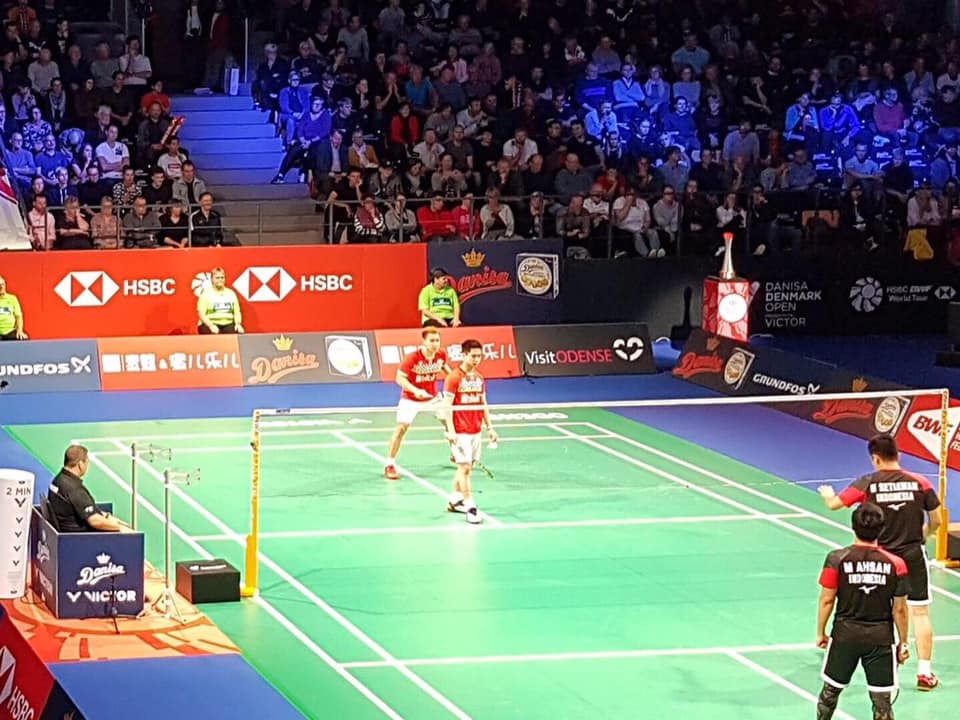
Danish Open, where both teams are from Indonesia. Photo credit: Indonesian Embassy in Denmark Facebook
5. Badminton 😊
In Indonesia, badminton is quite big, and it is one of the most popular sports. Not necessarily to be the kind of sports where most Indonesians would play, but definitely, there are many world-famous badminton athletes from Indonesia who have won many prestigious tournaments. I remember growing up watching badminton tournaments streamed on the TV, and sometimes there were Danish badminton players too. I can’t remember the name of the players back then, but nowadays, the most famous Danish badminton player is from the Men’s single, Viktor Axelsen. While in Indonesia, our current most famous players are probably Marcus Fernaldi Gideon / Kevin Sanjaya Sukamulyo. Quite happy that I have watched both the Indonesian Open and Denmark Open live in the stadium, in which in Odense, Denmark, I met in person with Viktor Axelsen, ha ha. On October 3–11 2020 in Aarhus, Denmark there will be Thomas and Uber Cup 2020 btw. I will definitely be there to witness them playing.

Yogyakarta’s King / Sultan Hamengkubuwono X and Danish Queen Margrethe II. Photo credit: Kraton Jogja Facebook
6. Royal Family
Denmark is a country with a constitutional monarchy system, where it has a kingdom, royal family, and ruled by a Queen. However, the Queen is more like a ‘symbol’, as it has Prime Minister who is elected democratically by the people (not directly elected, but through some political parties agreement) and she does the ‘daily work’ leading the nation. Indonesia is a Republic country, that has a President. What is the similarity then? On a country level, the government system in both countries are different, however, in my hometown, Yogyakarta, we have a kingdom where the King / Sultan rules the city and acts as a governor. So, we also have a royal family and monarchy, but the King is involved in the administration part, not just being a symbol. Kinda like absolute monarchy, but in a province level. Another info, our previous Sultan, Sultan Hamengkubuwono IX was Indonesia’s second Vice President, where he did not become Yogyakarta’s governor. A quite unique thing, right?

7. Olsen Banden and Warkop DKI
When I saw the Olsen Banden movie for the first time, I felt so familiar with it. First, I thought that it was because of the humor they used that was just so similar to Indonesian humor. But then there was actually something else than that. The three main characters really reminded me of the all-time popular Indonesian comedy trio and movies, Warkop DKI or Dono, Kasino, Indro (the real name of each character). The movies were also a legendary old comedy with three male main characters doing silly stupid things all the time. Their first movie was from 1979, so it was also very old, although not as old as Olsen Banden. The main difference between Olsen Banden and Warkop DKI is though, that in Olsen Banden there was one character who acted as a leader and had the best mastermind (Egon). While in Warkop DKI, the one character who stood out was the most stupid one who always had the worst luck (Dono). This is the Wikipedia reference, and for the record, although in Wikipedia it shows that they had five members. While in reality, the most notable ones who showed up in most of the movies were only three of them as mentioned earlier (Dono, Kasino, Indro) https://en.wikipedia.org/wiki/Warkop

Sumatravej in Marselisborg, Aarhus, Denmark
Bonus: Sumatra and Java
Many people don’t know this. But in Aarhus, there is a street in the Marselisborg area named Sumatravej (if it is literally translated, this means the road to Sumatra). There is also a street in Aarhus named Javavej and Celebesvej. While in Copenhagen in the Kastrup area, there is a street named Javavej, Borneovej, and Sumatravej. Those streets are not located in crowded areas. Therefore, many people are not aware of them. Java, Sumatra, Borneo, and Celebes are the names of the big islands in Indonesia (Celebes is the old name of Sulawesi). Quite funny that Denmark has those streets, despite the long distance between Denmark and Indonesia. What a random fun fact of the day!


